
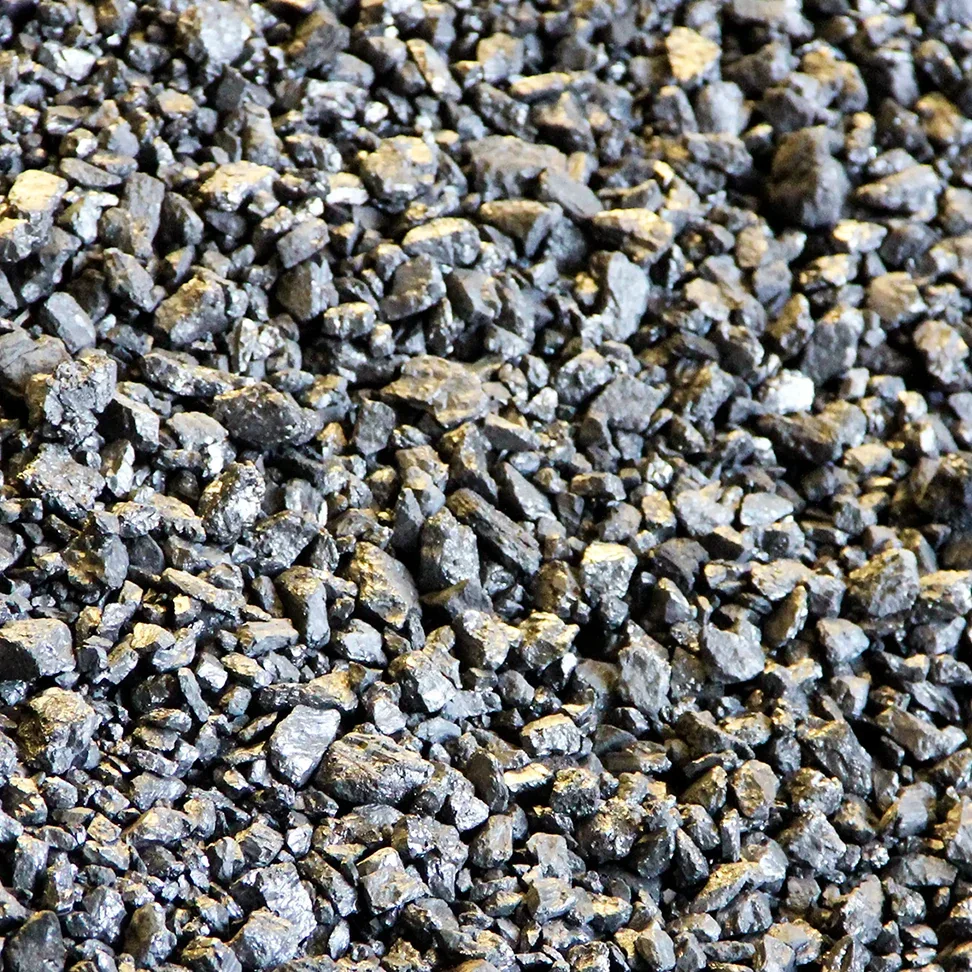
Submerged arc furnace (SAF) operations for ferroalloy production — FeSi, SiMn, and silicon metal — consume significant quantities of carbon reductants. Semi-coke (also called blue coke or lantan) has emerged as a cost-effective alternative to traditional metallurgical coke, offering competitive carbon content with lower sulfur and controlled reactivity.
Why Semi-Coke for Ferroalloys?
Traditional metallurgical coke has been the default SAF reductant, but semi-coke offers several advantages for ferroalloy producers:
| Property | Semi-Coke | Met Coke | Impact |
|---|---|---|---|
| Fixed Carbon | 82–88% | 85–90% | Slightly lower but compensated by lower cost |
| Sulfur | 0.2–0.5% | 0.5–0.8% | Less S transfer to alloy product |
| Volatile Matter | 5–10% | 1–2% | Higher VM aids initial reactivity |
| Ash | 5–10% | 10–13% | Less slag, lower energy consumption |
| Cost (FOB China) | Lower | Higher | 15–25% cost advantage per ton carbon |
Key Specifications for SAF Use
Sizing Requirements
Proper sizing is critical for SAF burden permeability:
- 10–30 mm: Small SAF furnaces, mixed with ore fines
- 20–60 mm: Standard SAF operation for FeSi/SiMn
- 30–80 mm: Large open-top furnaces requiring maximum permeability
Fines Control
Fines (<5 mm) must be limited to 5–8% maximum. Excess fines cause:
- Channeling and uneven gas distribution
- Increased dust losses from the furnace top
- Bridging in the charge column
Chemical Limits
For FeSi 75 production:
- Ash ≤8% (lower is better — each 1% ash increase raises specific energy by ~15-20 kWh/t)
- Phosphorus ≤0.02% (P transfers readily to alloy)
- Sulfur ≤0.5% (less critical than P but still monitored)
Trial Methodology
Before committing to bulk semi-coke supply, ferroalloy producers should:
- Order a trial lot (20–40 MT, typically 1 container)
- Run controlled heats comparing semi-coke against current reductant
- Track: specific energy (kWh/t alloy), alloy grade compliance, slag volume, furnace stability
- Calculate: effective cost per ton of carbon delivered to the metal, not just cost per ton of reductant
- Document: any changes in tap frequency, electrode consumption, or furnace lining wear
When to Choose CAC Instead
Calcined anthracite (CAC) in lump form (10–30 mm) may outperform semi-coke when:
- Higher FC (>92%) is needed to reduce reductant volume in the burden
- Very low ash (<5%) is required for high-purity silicon or specialty alloy grades
- Supply chain prefers a single Ningxia-origin supplier for both CAC and semi-coke
Related Products
- Semi-Coke — full product specifications and grades
- Calcined Anthracite Coal (CAC) — high-FC alternative for ferroalloy reductant
- Ferroalloy Applications — complete application guide